
Every week on a construction project, teams agree what they’re going to get done.
Areas will be handed over. Installations will start. Packages will finish. One trade will complete its work so the next can move in.
Then Friday comes around.
How much of it actually happened?
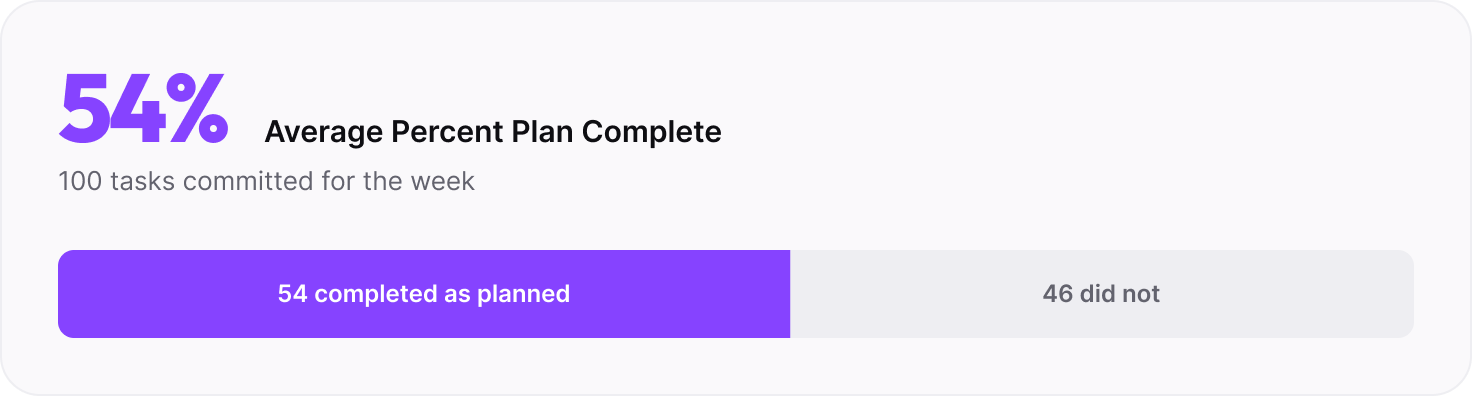
Research referenced by the Lean Construction Institute puts the average at around 54%. In other words, on a traditionally managed project, only about half of the work planned for a given week is completed within that week.
That should be an uncomfortable number.
Because if roughly half of this week’s plan doesn’t happen, the problem isn’t confined to this week. Every missed commitment has the potential to affect something that comes after it.
And yet many projects don’t have a consistent way of measuring that gap.
A master programme can contain thousands of activities stretching months or years into the future. It gives the project its overall sequence and tells each team where its work needs to fit.
But a programme can only succeed if the work underneath it happens with some degree of reliability.
Think about a normal weekly planning meeting.
A contractor says an area will be finished by Wednesday. Another team plans to start Thursday. Materials are expected Tuesday. An inspection is booked. Access is supposed to be available.
None of those commitments looks particularly dramatic on its own. They’re simply the things that need to happen to keep the project moving.
Then one slips.
The Wednesday finish becomes Friday. The team arriving Thursday can’t start. Their work moves into the following week, where it begins competing with work that was already planned for that period.
Do that once and the project probably absorbs it.
Do it repeatedly across multiple packages and the effect starts building.
The master programme may eventually show the consequence. What it doesn’t naturally tell you is something much simpler: are the commitments being made every week actually being kept?
Percent Plan Complete, or PPC, measures the proportion of tasks planned for a particular week that were actually completed as committed.
The idea comes from the Last Planner System. Rather than relying entirely on a top-down view of what should happen according to the programme, the people closest to the work make commitments about what they believe can realistically be delivered during the coming week.
At the end of that week, the team checks what actually happened.
If ten tasks were committed to and seven were completed as planned, the PPC for that week is 70%.
Simple.
But that percentage tells you something important about the project that the master programme alone doesn’t: how reliable is the team at turning weekly plans into completed work?
That matters because the programme is built on the assumption that thousands of individual pieces of work will happen closely enough to plan for the overall sequence to hold.
When they don’t, the effect accumulates.
The figure from the research is around 54%.
So imagine walking out of a weekly planning meeting with 100 activities agreed for the coming week.
If the project performs around that average, only 54 will actually be completed as planned.
Some move into next week. Some affect another contractor. Some consume available float. Some create additional coordination work. Others may have no immediate effect at all.
A missed weekly commitment doesn’t always look like a project delay.
If an activity has enough float, the overall completion date might remain unchanged. The project can absorb the miss, so everything still appears manageable at programme level.
The team said the work would happen, and it didn’t.
If the same pattern continues week after week, the project is repeatedly using up the room it had to absorb problems. By the time that behaviour becomes obvious in a milestone date, the team may have been living with unreliable weekly delivery for months.
This is where PPC becomes particularly useful alongside CPM.
They answer different questions.
The programme tells you what should happen and calculates where the project is heading based on the progress reported against it.
PPC asks whether the work people said they would complete this week actually got done.
Those two views can tell very different stories.
A project could still show its major milestones on programme while its weekly PPC has started falling. The completion date hasn’t moved yet, but fewer commitments are being kept.
That deserves attention.
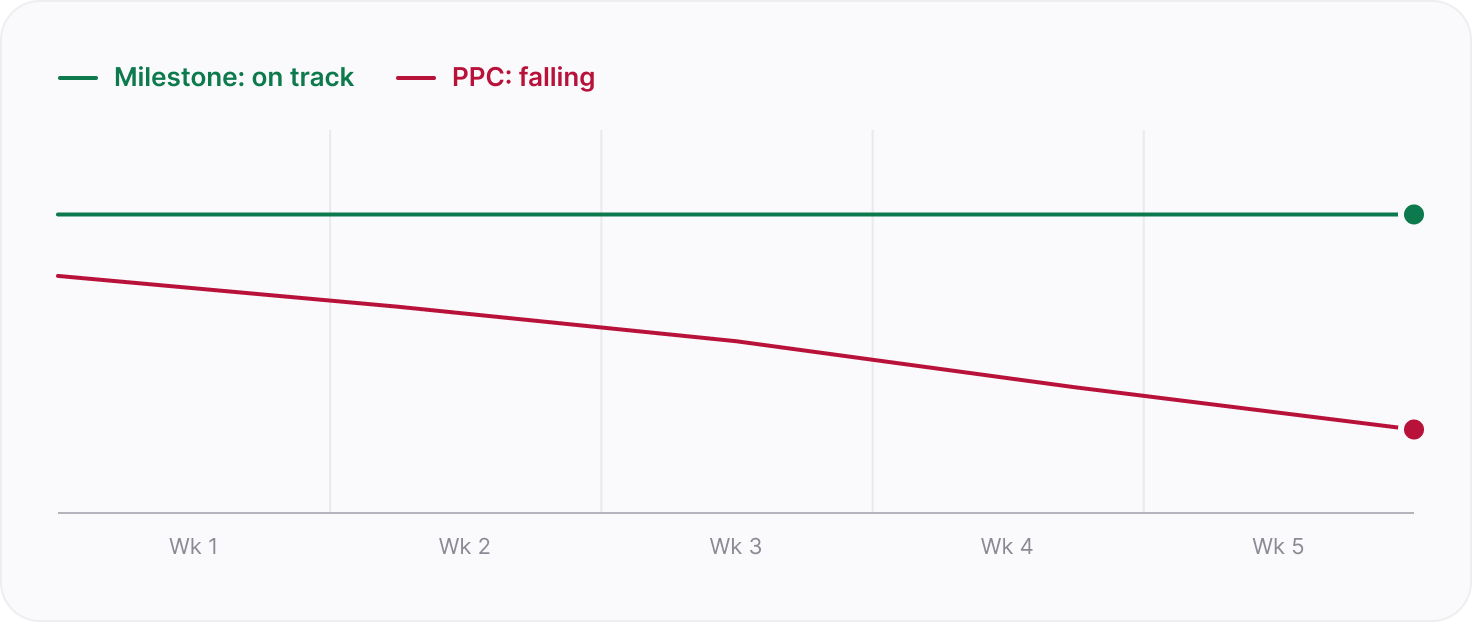
Because falling plan reliability gives the team something to investigate before the is uenecessarily becomes visible as schedule delay.
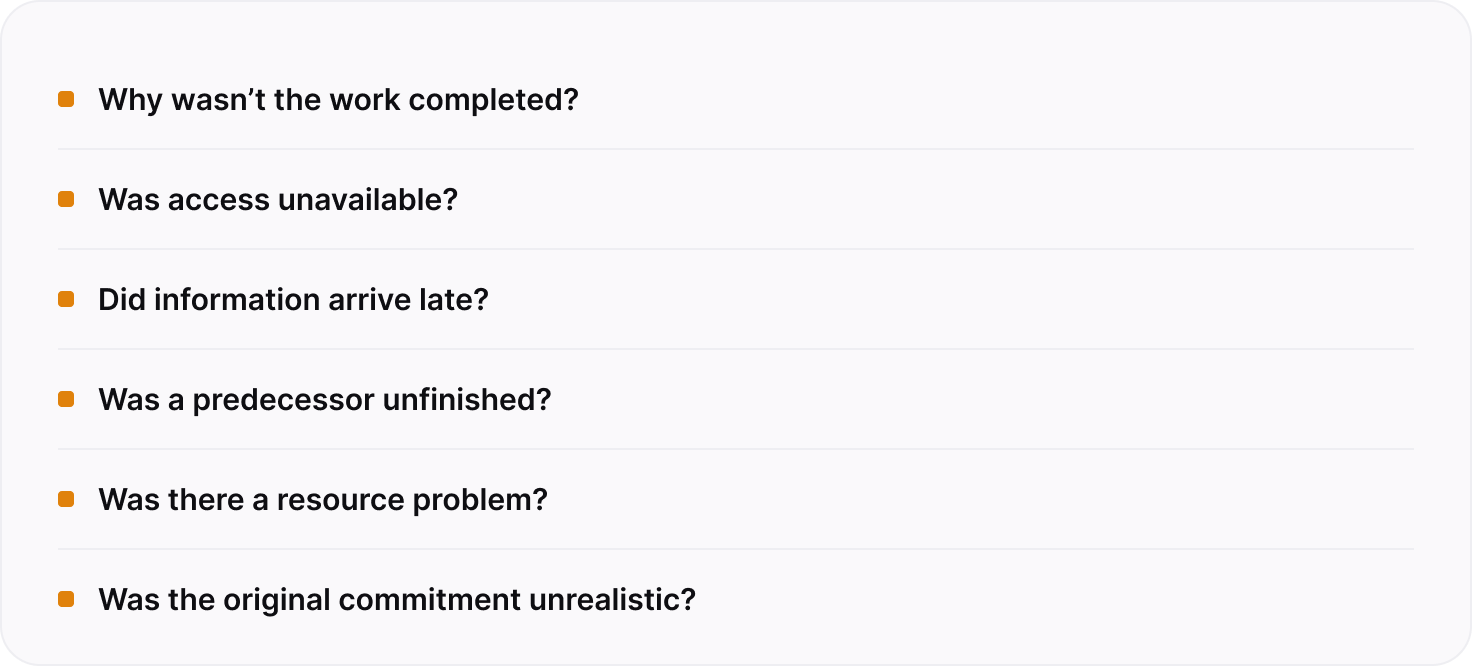
The percentage alone isn’t the answer. It tells you where to start asking questions.
And because it refreshes every week, the team doesn’t have to wait for a major programme movement before having that conversation.
One of the useful ideas behind the Last Planner System is the difference between what should, can, will and did happen.
The master programme establishes what should happen.
As work approaches, the team looks at the actual conditions around it to understand what can happen. Constraints need to be identified and cleared before the work is treated as ready.
The people responsible for delivering it then make a commitment about what will happen during the week.
Finally, the project records what did happen.
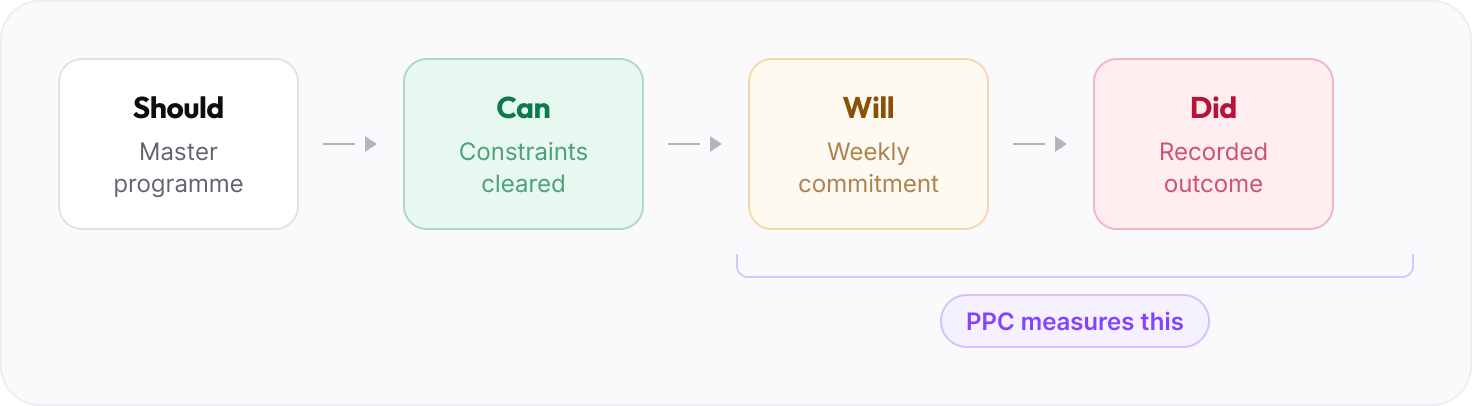
PPC measures the gap between those last two.
That gap is worth paying attention to.
If a contractor consistently commits to ten tasks and delivers nine, the project has a relatively reliable basis for planning the work around them.
If another consistently commits to ten and delivers five, the problem goes beyond five unfinished tasks. Other teams are making decisions based on commitments that regularly don’t hold.
That makes the project harder to coordinate.
And over time, it makes the programme harder to trust.
There’s an obvious risk when any new project metric is introduced: people start managing the number instead of the problem behind it.
PPC shouldn’t become another percentage added to a dashboard because somebody wants another green box.
Its value comes from what the number tells the team about the reliability of the planning process.
The research cited in Beyond the Critical Path found a relationship between improving plan reliability and improving productivity. Projects that moved PPC from around the mid-50s towards 70% showed clear improvement, while case studies reaching the 80% to 90% range recorded the strongest productivity gains.
That relationship makes sense.
Reliable work is easier to plan around.
When teams can depend on commitments being kept, handovers become more predictable and the next activity has a better chance of starting when expected. When commitments repeatedly fail, the project spends more of its time reacting to what didn’t happen.
So improving PPC isn’t about making a dashboard look better.
It’s about making next week more dependable than this week.
Suppose PPC falls from 78% one week to 62% the next.
The useful response isn’t simply, “We need to get that number back up.”
The question is: why did the commitments fail?
If several activities couldn’t start because drawings weren’t approved, that tells the team something.
If work repeatedly moves because access isn’t available, that tells them something else.
If one contractor consistently commits to more work than it can deliver, there’s another conversation to have.
Once missed commitments are recorded consistently, patterns begin to appear.
And those patterns can be acted on.
The team can start removing recurring constraints earlier, challenging unrealistic commitments before they enter the weekly plan and understanding which parts of the project are becoming less predictable.
That’s much more useful than discovering several reporting periods later that an activity has moved.
PPC isn’t a replacement for the master programme.
It works because it answers a question the programme wasn’t designed to answer.
The programme still tells the project where it needs to go. It establishes the sequence, dependencies and dates that hold everything together.
PPC tells you whether the weekly commitments needed to get there are holding.
You need both views.
Because a completion date can still look achievable while the reliability underneath it is getting worse.
And if only around half of what gets planned each week is actually happening, that’s something worth knowing now, not several months from now when the consequences finally reach a milestone.
The most useful project question on a Friday might therefore be surprisingly simple.
We said we’d do this. Did we?
Then ask why.
Uconia connects weekly planning directly to the master programme, giving project teams a way to track commitments, measure Percent Plan Complete and understand why planned work wasn’t delivered.
Rather than maintaining weekly plans separately from Primavera P6, teams can connect the work being committed on site with the activities driving the wider programme. PPC can then be tracked as part of the project’s normal planning process, giving teams an earlier view of whether delivery is becoming more or less reliable.
The master programme tells you where the project needs to go.
Uconia helps you see whether this week’s commitments are actually getting you there.