Construction has never had more ways to see what’s happening on site.
Photos can be captured continuously. Drones can survey large areas quickly. Cameras can document progress. Reality capture can create a detailed visual record of how the project is developing.
That visibility is useful.
But there’s a point where seeing more of the project can create a false sense that we also know more about its progress.
Because some progress is visible.
Some isn’t.
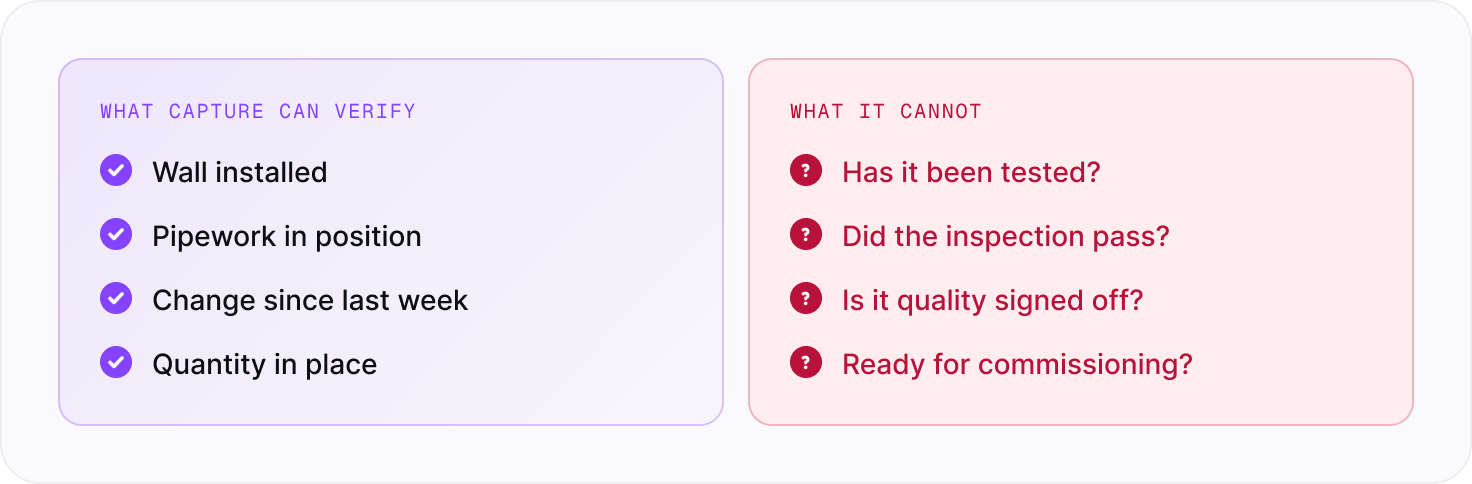
You can photograph an installed wall. You can capture pipework going into position. You can compare what physically exists today with what existed last week.
But what does a photograph of a system tell you about whether it has been tested?
What does a video tell you about whether a quality check passed?
What does reality capture tell you about commissioning readiness?
There are parts of a construction programme where physical progress and actual completion are closely related. There are others where they’re very different things.
And if we want a reliable picture of project progress, we need to understand the difference.
There’s an obvious appeal to automated progress verification.
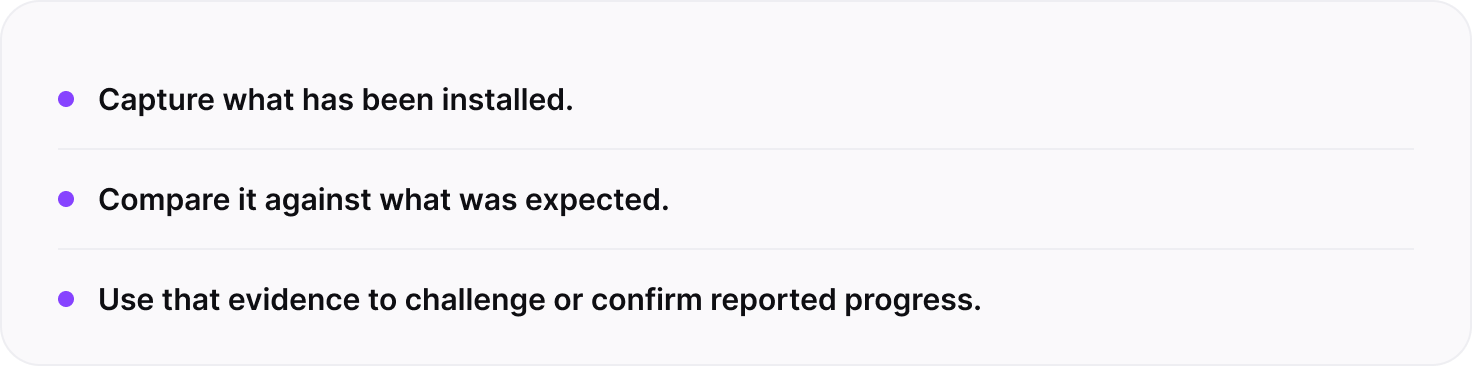
Instead of relying entirely on somebody walking the site, gathering updates and manually reporting progress, technology can capture physical conditions and provide an independent record of what has been built.
For the right activity, that can be incredibly useful.
If the programme says a physical installation should be substantially complete and site capture shows that half of it is still missing, there’s a useful discrepancy to investigate.
But construction programmes contain far more than things that can be seen.
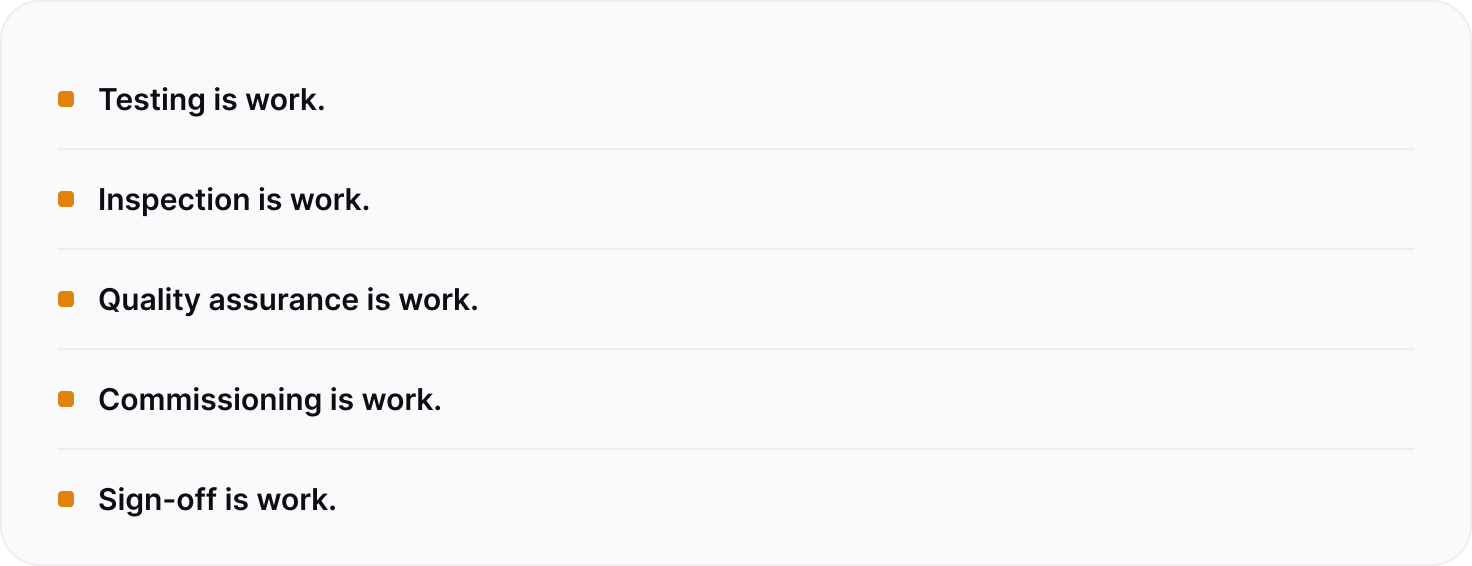
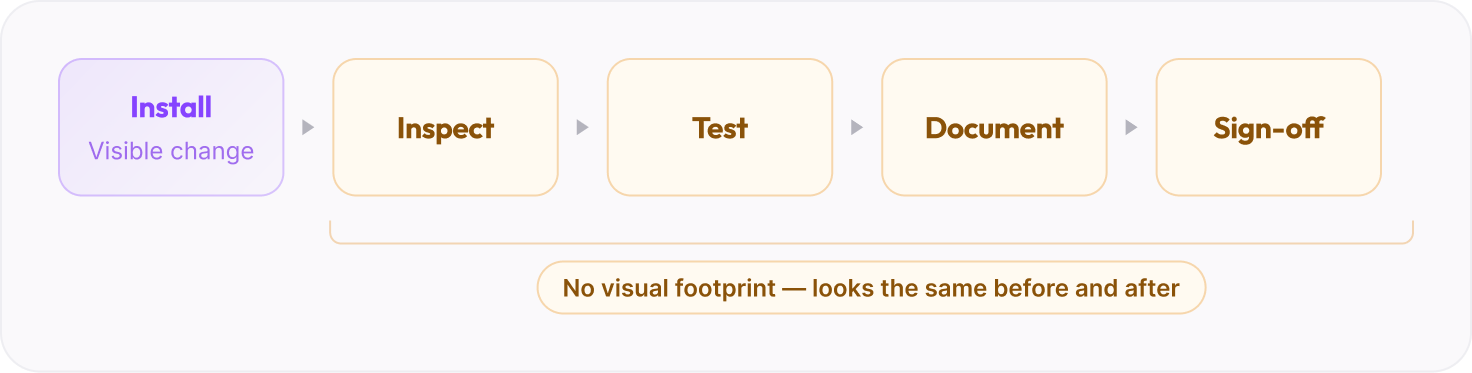
And in many cases, completing those activities doesn’t result in a new physical object appearing on site.
The equipment may look exactly the same before and after a successful test.
The room may look identical before and after an inspection.
A system can appear physically complete and still be nowhere near ready for handover.
That’s where relying too heavily on visual evidence starts to become a problem.
Imagine a piece of equipment has been installed.
A photograph can prove that it’s there.
Depending on the technology being used, physical capture may be able to verify its location and compare the installation against a model or expected condition.
Useful information.
But the programme activity might not simply be “install equipment.”
There may be inspections to complete. Testing might be outstanding.
Documentation may need approval. Quality checks could still be open. The equipment may need to form part of a larger system that hasn’t yet been commissioned.
Visually, the installation looks finished.
Operationally, it may not be.
That distinction becomes increasingly important as a project moves towards testing, commissioning and handover.
Earlier in construction, progress can often be represented by visible changes to the site.
Something wasn’t there, then it was.
Later, a significant amount of progress happens through verification, testing, documentation and acceptance.
A camera can continue recording the site.
But there’s less for it to see.
This is easy to overlook when discussing automated progress tracking.
A programme activity is an activity because something needs to happen, not because something needs to become visually different.
Consider a quality inspection.
Before the inspection, the installation exists.
After a successful inspection, the installation still exists.
The important change is its status.
The same is true for testing.
Before the test, the system may appear complete. After the test, it may look exactly the same. But the project now knows something it didn’t know before: whether that system performs as required.
Commissioning makes the gap even clearer.
A commissioning programme can involve sequences of checks, tests, dependencies and approvals that determine whether systems are genuinely ready to operate.
Much of that progress can’t be understood simply by looking at the physical asset.
You need information.
And very often, the people with the best information are the people actually delivering, testing and approving the work.
Ask somebody responsible for an upcoming activity whether they’re ready to start and you’ll often get information that doesn’t exist anywhere visually.
The installation might be complete, but testing hasn’t passed.
The area might look ready, but access hasn’t been formally released.
The equipment might be in place, but a prerequisite check is still outstanding.
The work might appear finished, but the team knows there’s a quality issue that needs to be resolved before the next activity can begin.
None of this means people are always right.
Human progress reporting has its own weaknesses. Updates can be subjective.
Information can arrive late. Different teams may interpret percentage complete differently.
That’s exactly why automated verification is valuable.
It gives the project another source of evidence.
But another source of evidence isn’t the same thing as a complete picture.
The mistake is assuming that because a technology can independently verify some progress, it can independently understand all progress.
It can’t.
The better approach is to stop looking for one method that can verify everything.
For work with a clear physical output, automated verification can be extremely useful.
But where completion depends on testing, quality checks, approvals, commissioning or other information that isn’t physically visible, the evidence needs to come from somewhere else.
That might be a completed inspection.
A test result.
A quality sign-off.
Or an update from the person responsible for delivering the activity.
The important thing is that the project knows what evidence actually represents completion.
Otherwise, there’s a risk of confusing physical presence with programme progress.
And those aren’t always the same thing.
There’s another problem with focusing too heavily on capturing what has already been built.
Projects also need to understand what happens next.
A perfect visual record of today’s site tells you a great deal about where the project currently stands.
It doesn’t necessarily tell you whether next week’s work is ready.
A photograph won’t tell you that an RFI affecting an upcoming activity has been sitting unanswered.
It won’t tell you whether a subcontractor is comfortable with the commitment it made for next week.
It won’t tell you why a task that looked achievable on Monday failed to complete by Friday.
And it won’t necessarily tell you which unresolved issue is about to prevent the next team from starting.
Those answers come from connecting programme information with the people responsible for executing the work.
That’s why progress verification is only one part of project certainty.
Knowing what happened matters.
Understanding what can happen next matters just as much.
There’s a useful role for automated verification here.
If somebody reports that an activity is 80% complete and physical evidence suggests something very different, the discrepancy deserves attention.
That’s valuable.
The technology is helping the team ask a better question.
But the answer might still require a person.
Perhaps the physical installation is further ahead than expected, but testing is behind.
Perhaps everything visible has been installed, but a quality issue means part of the work needs to be revisited.
Perhaps the activity itself has been interpreted differently by the person reporting it and the person reviewing the capture.
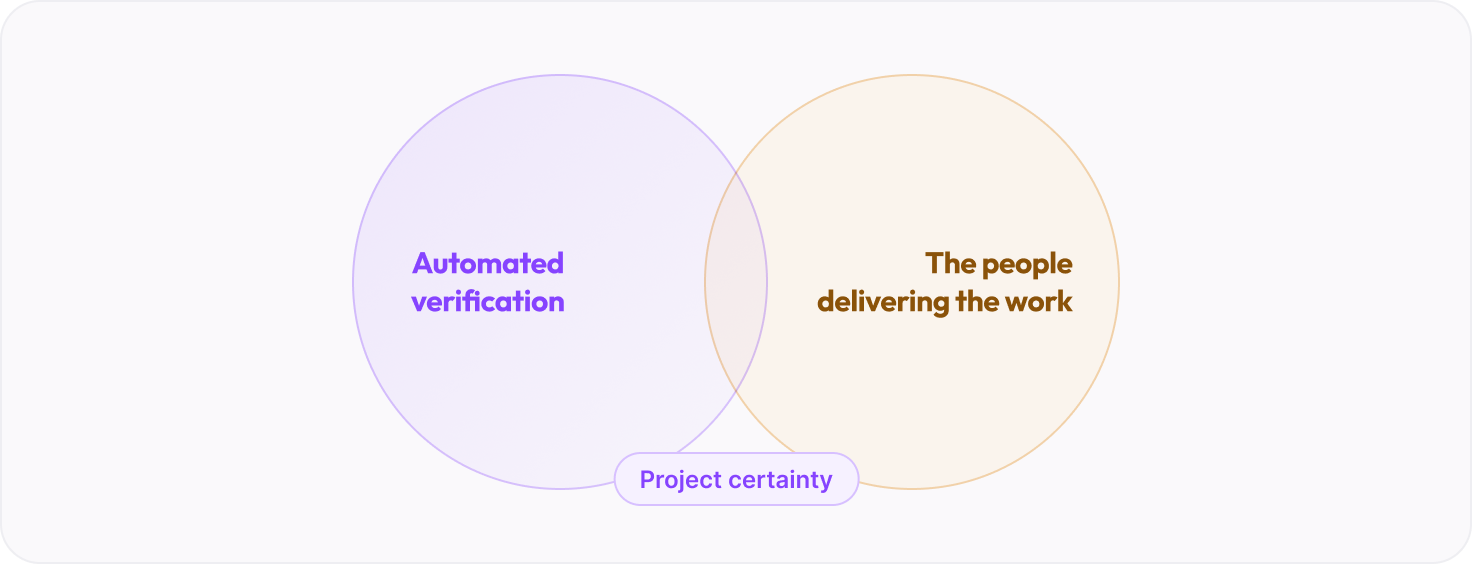
The verification gives the team evidence.
The people delivering the work give it context.
Project certainty comes from connecting those pieces rather than expecting one of them to answer every question.
Because the real question isn’t simply whether something can be seen on site.
It’s whether the project has enough reliable information to understand where the work stands, what still needs to happen and whether the next activity is genuinely ready to begin.
Sometimes a camera can help answer that.
Sometimes it can’t.
Knowing the difference matters.
Put the two together and the project gets a much stronger view than either source could provide alone.
Construction is collecting more information than ever.
That’s a good thing, as long as we’re clear about what each piece of information can actually tell us.
A photograph tells us something.
A video tells us something.
Reality capture tells us something.
A programme update tells us something.
A test result tells us something.
And the person responsible for delivering the work knows something too.
Project certainty comes from connecting those pieces rather than expecting one of them to answer every question.
Because the real question isn’t simply whether something can be seen on site.
It’s whether the project has enough reliable information to understand where the work stands, what still needs to happen and whether the next activity is genuinely ready to begin.
Sometimes a camera can help answer that.
Sometimes it can’t.
Knowing the difference matters.
Uconia is built around the idea that reliable project information needs to come from the work itself and the people responsible for delivering it.
Teams can update progress directly from site against the activities they’re responsible for, while the programme remains connected to Primavera P6.
Where automated progress verification is appropriate, that evidence can strengthen the picture rather than trying to replace the information that only the delivery team can provide.
The result is a more complete view of execution, from visible installation progress through to testing, quality and commissioning activities that don’t have a simple physical object to track.
Because seeing what has been built is valuable.
Knowing whether the work is actually complete is what the programme needs.